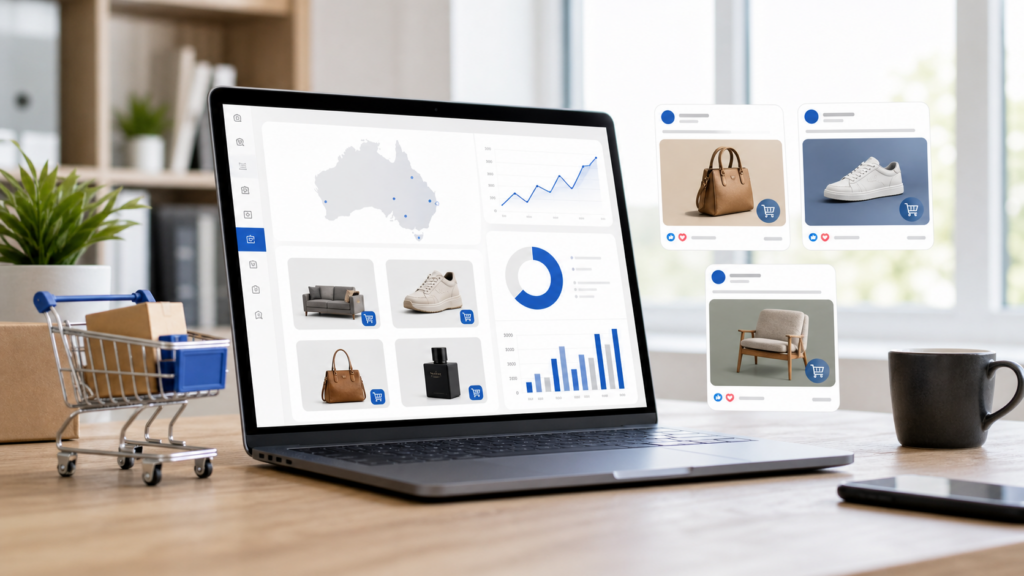
Online shopping in Australia is still growing, but shoppers are tougher to win than they were a few years ago. Australia Post reported that Australians spent $82.6 billion online in 2025, up 14% year on year, while 9.8 million households shopped online. That is good news for store owners. It also means more brands are chasing the same scroll, click, cart, and repeat purchase.
For many stores, facebook advertisement services Australia means getting help with Meta ads across Facebook, Instagram, Messenger, and the wider Meta network. The best work starts before an ad goes live: tracking, product feeds, creative testing, audience planning, landing pages, and reporting all need to pull in the same direction.
What Facebook advertisement services Australia include
Facebook advertisement services Australia usually cover campaign planning, creative testing, Meta Pixel and Conversions API setup, product catalogue work, audience strategy, budget pacing, performance reporting, and ongoing campaign changes. For e-commerce stores, the job is turning product interest into profitable purchases, then feeding better data back into Meta.
A store owner can boost a post in five minutes. Professional Facebook ads work connects your website, product feed, audience signals, and creative so Meta can learn which shoppers are most likely to buy.
For e-commerce, a proper service usually includes account review, Pixel setup, Conversions API planning, product catalogue checks, ad creative briefs, sales campaign builds, budget checks, and reporting on cost per purchase, sales, cart value, and repeat customer signals.
If your store also needs stronger organic demand, Circular Marketing’s social media marketing services can support the paid work with content that keeps your brand visible between campaigns.
Why Australian e-commerce stores use Meta ads
Meta ads suit e-commerce because they let stores show visual products to people who may not be actively searching yet. A shopper might not type “linen summer dress Australia” into Google today, but they may stop for a strong offer, product demo, or customer-style video.
Search ads capture demand that already exists. Facebook and Instagram ads can create demand earlier. That makes them useful for fashion, beauty, homewares, pet products, food, supplements, gifts, fitness gear, digital products, and niche Australian brands with a clear visual angle.
Meta’s own Advantage+ shopping campaign system is built for retail and e-commerce advertisers. Meta describes it as a way to personalise ads at scale through machine learning, which helps stores test more product and creative combinations than a small team could manage by hand.
Australian shoppers are bargain-aware. Australia Post’s eCommerce Report notes that 81% of shoppers look around for deals. That does not mean every ad needs a discount. It means your offer has to be obvious.
Store setup before your first campaign
Good ads cannot rescue a messy buying path for long. Before spending heavily, an e-commerce store should check tracking, product pages, mobile speed, checkout flow, delivery information, returns, reviews, and payment options.
Start with the website. If the product page loads slowly, hides shipping costs, or gives shoppers thin product details, paid traffic gets expensive fast. Facebook ads amplify what already exists in the store.
Your pre-launch checklist should cover:
- Product pages with clear photos, price, size, delivery, returns, and stock details.
- Mobile checkout tested on iPhone and Android.
- Meta Pixel firing ViewContent, AddToCart, InitiateCheckout, and Purchase events.
- Product catalogue connected and approved.
- UTM tracking added to campaign links.
- Email or SMS recovery for abandoned carts.
- A reporting view that separates revenue from profit.
If your store needs conversion work before paid media, the web development team can help tighten the shopping path before you send more traffic to it.
Creative that sells without sounding pushy
Meta ads reward creative variety. E-commerce stores need product shots, user-style videos, offer-led graphics, comparison angles, unboxing clips, founder videos, and proof points. One polished brand ad is rarely enough, because different shoppers need different reasons to stop and click.
The strongest creative usually shows the product quickly. Do not spend the first five seconds setting a mood. Show the item, the problem it solves, the offer, or the result.
For a new Australian store, test product demos, bundles, free shipping offers, review-led clips, sizing answers, delivery answers, and comparison ads against common alternatives.
Content matters here. Strong paid ads need a steady supply of fresh visuals and short scripts. Circular Marketing’s content creation services are a natural fit when a store has the budget for ads but not enough creative to test.
Campaign structure for new stores
New e-commerce stores should keep Meta campaigns simple. Start with one sales-focused campaign, a small group of creative tests, and a clean reporting plan. Split campaigns only when you have a clear reason.
A beginner account often gets messy because every idea becomes its own campaign. That spreads the budget too thin and gives Meta too little data. A cleaner structure works better.
| Campaign type | Purpose | Best fit |
|---|---|---|
| Sales campaign | Find buyers and optimise for purchases | Stores with working checkout and tracking |
| Retargeting campaign | Bring back product viewers, cart starters, and past customers | Stores with enough website traffic |
| Creative testing campaign | Compare hooks, formats, products, and offers | Stores producing regular creative |
| Catalogue campaign | Show dynamic product ads from the feed | Stores with multiple SKUs |
If your store also runs search ads, connect the paid media plan. Meta can introduce the product, while Google captures higher-intent searches. Circular Marketing’s Google Ads services can sit beside Meta campaigns.
Budgets, testing, and real numbers
Facebook advertisement services Australia should give budget advice based on order value, margin, conversion rate, creative volume, and sales targets. A store selling $35 products cannot judge campaigns the same way as a store selling $450 furniture items, because the allowable cost per purchase is completely different.
Before setting a daily budget, know your average order value, gross margin, conversion rate, repeat purchase rate, break-even cost per purchase, and target return on ad spend.
Here is a simple example. If your average order value is $100 and your gross margin is 50%, you have $50 before fulfilment, platform fees, and overheads. Spending $45 to get that first purchase may be acceptable if repeat orders are strong. It may be a loss if most customers buy once.
Begin with a test budget you can afford to lose. That sounds blunt, but it is honest. Early spend buys data: which product gets clicks, which creative gets saves, which landing page holds attention, and which offer turns interest into checkout.
Tracking, privacy, and clean reporting
Tracking is where many e-commerce Meta accounts fall apart. The Meta Pixel tracks browser events, while the Conversions API sends server-side events from your website or commerce platform. Meta says the Conversions API creates a connection between your marketing data and Meta’s ad systems, which can help measurement when browser tracking is limited.
For store owners, the plain-English version is this: Pixel alone is rarely enough anymore. Conversions API helps Meta receive cleaner purchase and checkout signals, especially when browsers, cookie settings, or consent tools reduce visibility.
Reporting also needs a human sense check. Ads Manager may not match Shopify, WooCommerce, GA4, Stripe, PayPal, or your accounting figures exactly.
Use a reporting rhythm that compares Meta reported purchases, store backend revenue, spend by campaign, blended cost per acquisition, profit after product and fulfilment costs, and returning customer sales. Circular Marketing’s reporting services are useful when you need one view of paid ads, SEO, content, and revenue instead of five disconnected dashboards.
Australian compliance points for social ads
Australian e-commerce ads must avoid misleading claims, hidden sponsorships, fake reviews, and unclear promotions. The ACCC has warned businesses and influencers to review social media testimonials and endorsements so consumers are not misled.
This matters because many e-commerce campaigns use UGC-style content, influencer videos, testimonials, reviews, before-and-after claims, and discount offers. If a creator was paid or gifted product, disclose it clearly. If you quote a review, keep it accurate.
Paid social can move fast. Consumer law still applies.
What to ask before hiring an agency
Before you hire an agency for facebook advertisement services Australia, ask how they handle tracking, creative testing, product feeds, reporting, and profit. A good answer should be specific to your store, your margins, your website, and your current sales volume.
Ask these questions before signing:
- Will you audit my Meta Pixel, Conversions API, and catalogue before launch?
- How many ad creatives do we need each month?
- Who writes the hooks, scripts, and offer angles?
- How do you report profit instead of only return on ad spend?
- What happens if the first month does not produce profitable sales?
- How do you separate testing spend from scaling spend?
- Will you review landing pages and checkout issues?
- How often will we speak, and what decisions will you need from me?
If an agency talks only about clicks and impressions, keep asking questions. E-commerce advertising has to connect to stock, margins, delivery, customer service, and repeat purchase behaviour.
For a wider plan across paid ads, SEO, content, and website improvements, Circular Marketing’s strategic planning service can map the work before the ad budget starts moving.
Key takeaways for Australian stores
Facebook ads can work for Australian e-commerce stores when the store, tracking, creative, and offer are ready. The channel is strongest when it shows products visually, tests multiple angles, and uses clean conversion data to find shoppers with real buying intent.
Keep these points close:
- Use Meta ads when your product can be shown clearly in images or video.
- Fix the website before scaling spend.
- Set up Pixel and Conversions API before judging results.
- Test creative every month, instead of once per quarter.
- Measure profit and cash flow, as well as ad platform revenue.
- Follow Australian Consumer Law on claims, reviews, and sponsored content.
- Pair paid ads with SEO, content, and email for stronger long-term sales.
If your store needs organic search growth as well as paid acquisition, the SEO service can help build demand beyond paid campaigns. For related planning, the blog post on measuring digital marketing ROI in Australia is a useful next read.
Facebook Ads Ecommerce Takeaways
Facebook advertisement services Australia can help e-commerce stores move from random boosting to structured sales campaigns. The work pays off when your offer is clear, your tracking is clean, and your creative gives Australian shoppers a reason to buy now.
Facebook Ads Ecommerce FAQs
Our Facebook advertising service covers audience setup, creative testing and conversion tracking. It can also work alongside organic social media management.