
A homeowner with a blocked drain in Parramatta, a tripping safety switch in Penrith, or a half-finished renovation in Campbelltown usually starts with one thing: a local search. They don’t want a theory lesson. They want a tradie who services their suburb, answers the phone, has decent reviews, and looks like they can do the job this week.
That is why local SEO for tradies matters so much. If your plumbing, electrical, building, roofing, or maintenance business does not appear in Google Search and Google Maps when someone needs a quote, another business gets the call.
Why local SEO for tradies turns searches into quote calls
Local SEO helps your trade business appear when nearby customers search for your service, suburb, or job type. Google says local rankings rely on relevance, distance, and prominence, which means your website, Google Business Profile, reviews, and local signals all work together.
For tradies, the search intent is often commercial from the first click. Someone searching “emergency plumber near me or “licensed electrician Blacktown is close to calling. Google’s local search research has reported that 76% of people who search nearby on a smartphone visit a related business within a day, and 28% of those searches lead to a purchase.
The winning business usually has these basics in place:
- A Google Business Profile that matches the services customers search for.
- Suburb and service pages that prove the business works in that area.
- Enough recent reviews to lower doubt before the first call.
- Call tracking that shows which pages and searches produce quote requests.
If you already invest in SEO services, this is the part that turns rankings into booked work.
Suburb and service pages that bring in the right jobs
A strong local SEO setup gives each major service and target suburb a useful page. These pages should answer what the customer wants before they call: what you do, where you work, what jobs you handle, and how to request a quote.
The biggest mistake is creating thin suburb pages with the same copy and a swapped suburb name. A useful page for “plumber Parramatta should mention the calls you take there, nearby service coverage, response expectations, common property types, and proof that you understand the area.

How to plan your suburb page map
Start with suburbs that already produce jobs, then add areas where you can respond quickly and profitably. A plumber who services the Hills District should not build pages for every town in New South Wales.
| Page type | Best use | Example for tradies |
|---|---|---|
| Core service page | Ranks for the main service across your wider area | Emergency plumbing, switchboard upgrades, bathroom renovations |
| Suburb service page | Targets a specific service in a specific suburb | Hot water plumber Parramatta, electrician Penrith, builder Marrickville |
| Problem page | Targets high-intent jobs with clear symptoms | Blocked drain, flickering lights, cracked tile repair |
| Proof page | Builds trust before the quote request | Recent projects, reviews, licenses, insurance, before and after work |
Good web design for service businesses matters here. If the page loads slowly or hides the phone number, better rankings will still leak leads.
Google Business Profile for plumbers, electricians and builders
Your Google Business Profile often appears before your website. For trade searches, it can be the first proof a customer sees: service category, reviews, photos, hours, calls, and service areas.
Google’s own guidance says businesses should keep profile information complete and accurate. For tradies, your primary category should match your money service. An electrician should choose the closest trade category and add service details that match real jobs.
Profile fields that affect trust
- Primary category: Choose the category closest to your main trade.
- Services: Add job types customers search for, such as burst pipes, switchboard upgrades, EV charger installs, renovations, and emergency callouts.
- Service areas: List real suburbs you can service, not every suburb in the state.
- Photos: Add job-site photos, vehicles, uniforms, completed work, and equipment. Avoid stock images if you can.
- Hours: Keep standard and emergency hours accurate, especially for after-hours trades.
- Website link: Link to the most relevant page, not always the homepage.
For more detail on map rankings, Circular Marketing has a related article on how to rank higher on Google Maps in Australia.
Reviews you can get while you are still on the tools
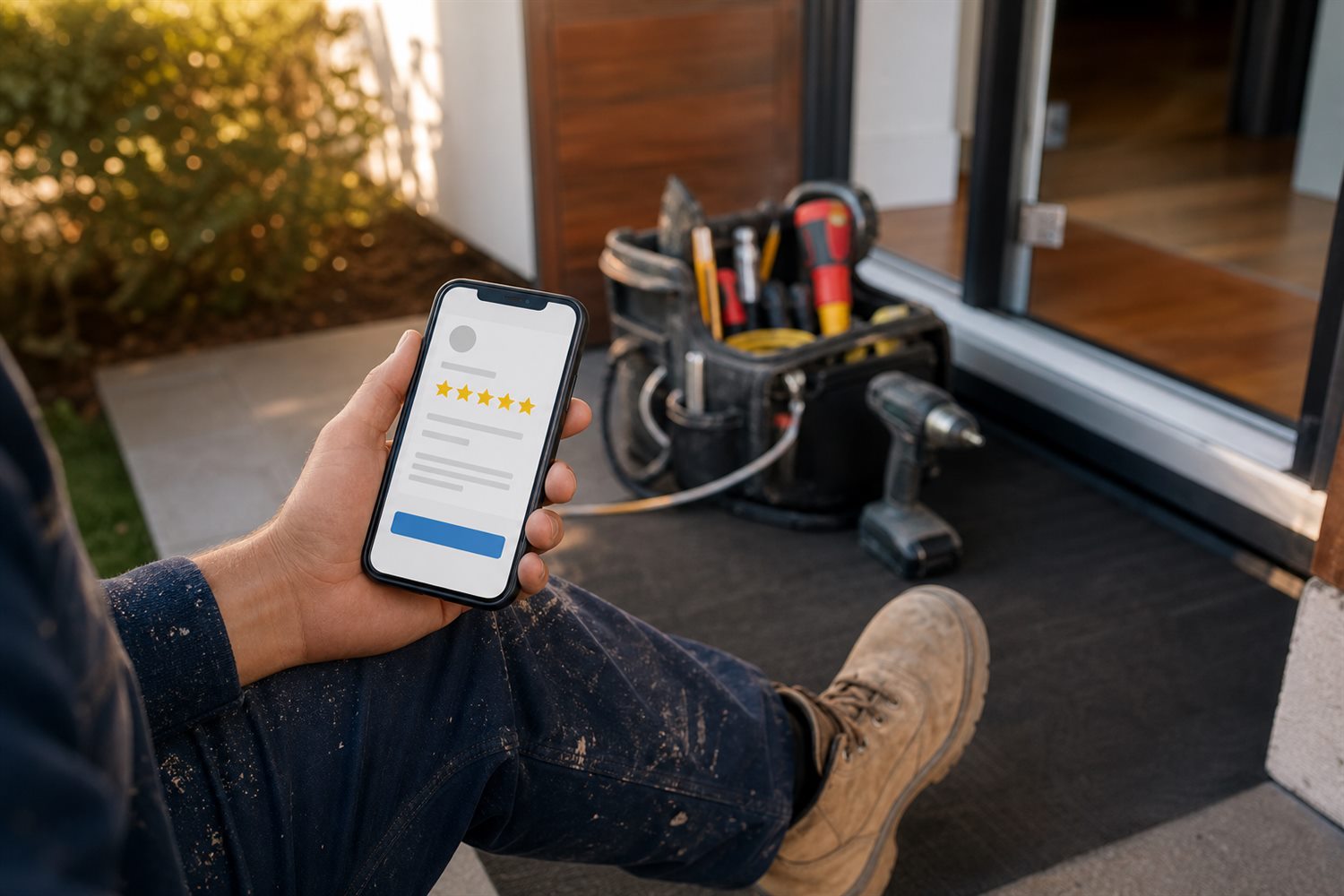
Reviews work because customers trust other customers before they trust your sales copy. The best time to ask is straight after a clean handover, while the customer is relieved the job is done and still has you in front of them.
Most tradies miss reviews because they ask too late or make the customer work too hard. Build a simple process into the end of the job. Send a direct review link by SMS, mention the specific job completed, and ask while the customer is happy with the result.
A simple review request script
Try this after a job goes well:
Thanks again for booking us today. If you’re happy with the work, could you leave a quick Google review… It helps local customers find us when they need the same job done. I’ll text you the link now.
Keep it direct. Don’t offer incentives, don’t pressure customers, and don’t ask only for five-star reviews. A steady pattern of honest reviews looks more natural and builds stronger trust.
Tracking quote calls without making reporting a mess
Local SEO should be judged by leads, not rankings alone. Track phone calls, form submissions, Google Business Profile actions, and quote requests so you can see which suburbs and services produce real money.
For many trades, the phone call is the sale lead. A homeowner with water coming through the ceiling is unlikely to fill out a long form. They tap the number. If you are not tracking calls, you may be undercounting the pages, ads, and map listings doing the heaviest lifting.

What to track each month
| Metric | Why it matters | Good monthly question |
|---|---|---|
| Calls from Google Business Profile | Shows map listing demand | Which suburbs and services drove the calls… |
| Calls from website pages | Shows which pages convert | Which pages need stronger proof or clearer calls to action… |
| Form quote requests | Captures non-urgent jobs | Which forms produce real booked work… |
| Conversion rate by page | Finds pages that rank but do not convert | Does the page match the searcher’s problem… |
| Cost per quote request | Connects SEO and paid ads to revenue | Which channel earns the best jobs… |
Clear marketing reporting helps here because a ranking report alone will not tell you whether quote quality is improving. If you also run paid campaigns, connect SEO reporting with Google Ads for local lead generation so you can compare organic and paid enquiries.
Common mistakes that cost tradies local jobs
The most expensive local SEO mistakes are usually basic. They make Google less confident, or they make the customer less likely to call. Fixing these often improves leads faster than publishing another batch of thin pages.
1. Using the same copy across every suburb
Duplicate suburb pages look lazy. Add specific job types, travel coverage, local proof, FAQs, and service notes for each area. If you cannot make a page useful, you may not need that page yet.
2. Hiding the phone number
On mobile, the phone number should be visible without hunting. Use click-to-call buttons, short quote forms, and clear emergency wording where relevant.
3. Chasing every suburb
More locations do not always mean more profit. Build around suburbs where you can respond quickly, win decent jobs, and avoid travel that eats the margin.
4. Treating reviews as an afterthought
A trade business with 12 old reviews will struggle against a competitor with fresh reviews mentioning real job types. Ask consistently, reply professionally, and use feedback to improve your service pages.
5. Publishing pages before the website is ready
Slow pages, broken forms, tiny text, poor mobile layouts, and vague service copy all hurt enquiries. Your website should make it easy for a stressed customer to trust you in under a minute.
Where electrician SEO, plumber SEO Australia and builder marketing differ
The local SEO foundations are similar across trades, but the buying triggers change by trade.
| Trade | Search intent | Page proof to include |
|---|---|---|
| Plumbers | Often urgent, with leaks, blocked drains, hot water and burst pipes | Emergency response areas, license details, after-hours process, recent repair photos |
| Electricians | Safety-driven, with tripping breakers, switchboards, smoke alarms and power faults | Electrical license, safety wording, inspection process, service guarantees |
| Builders | Research-heavy, with renovations, extensions, timelines and quote comparisons | Project photos, timelines, renovation process, insurance, testimonials, budget ranges |
Electrician SEO should build confidence around safety and licensing. Plumber SEO Australia needs strong emergency and suburb coverage. Builder marketing often needs deeper proof because the job value is higher. A builder may need case studies and content from professional content creation, while a plumber may need tighter call tracking.
Done-for-you local SEO for tradies
If you are on the tools all day, you probably do not want to spend your evenings writing suburb pages, fixing analytics, and uploading job photos. Done-for-you local SEO gives your business a system: plan the suburbs, fix the website, improve the Google Business Profile, build useful pages, and track quote calls.
The right partner should explain the work in plain English. Ask which pages they will build, how they will avoid duplicate suburb content, which calls and forms they will track, and what reporting you will see each month. You can also compare service options through Circular Marketing’s article on what to expect from professional SEO marketing services.
If your website needs work before SEO can convert, pair the campaign with trade-focused web development. If you need a broader plan across SEO, Google Ads, and content, start with digital marketing strategy planning.
What tradies gain when the basics are fixed
Local SEO works best when it is practical. The aim is not to win vanity rankings. The aim is to get found by the right customer, in the right suburb, for the right job.
- More quote calls from suburbs you actually service.
- Stronger Google Maps visibility for high-intent searches.
- Service pages that answer customer questions before the first call.
- Reviews that build trust before a competitor gets a chance.
- Reporting that shows which services and suburbs produce booked work.
Final Thoughts
Local SEO for tradies should feel close to the work: suburbs, calls, reviews, job photos, quote forms, and clear proof that you can do the job. If you want more customers finding you in the suburbs you care about, speak with Circular Marketing about a local SEO plan built around real trade enquiries.