
Getting to the top of Google can put your business in front of Australians looking for what you sell. “Top of Google” can mean a paid ad, a place in the local map pack, an organic listing, or a mention inside an AI-generated result. Each position follows different rules.
For most small and medium businesses, the best plan combines quick visibility with steady organic growth. Choose searches you can realistically win, build pages that answer them well, fix technical problems, and strengthen signals Google can verify. A goal to “rank first on Google” becomes useful when it names a service, location, audience and type of result.
How Google decides which pages rank
Google uses automated systems to match a search with relevant, useful and trustworthy results. It looks at the meaning and intent of the query, the content on each page, links between pages, location signals and the quality of the user experience. No single score or technical trick decides the order.
Google’s own Search Essentials recommends people-first content, prominent use of the words customers search for, crawlable links and clear information that search engines can interpret. Its ranking systems also examine how pages link to one another and can assess individual passages for relevance.
Relevance comes before clever SEO
A page for “commercial electrician Sydney” should clearly describe commercial electrical work in Sydney. A generic electrical page with one mention of Sydney gives Google little reason to treat it as the best match. The title, main heading, service details, examples, internal links and supporting evidence should all point in the same direction.
Trust grows when a page identifies who wrote or reviewed it, cites dependable sources, shows first-hand experience and makes claims a reader can check. Circular Marketing applies that same standard across its SEO services for Australian businesses: clear scope, traceable work and reporting tied to enquiries and sales.
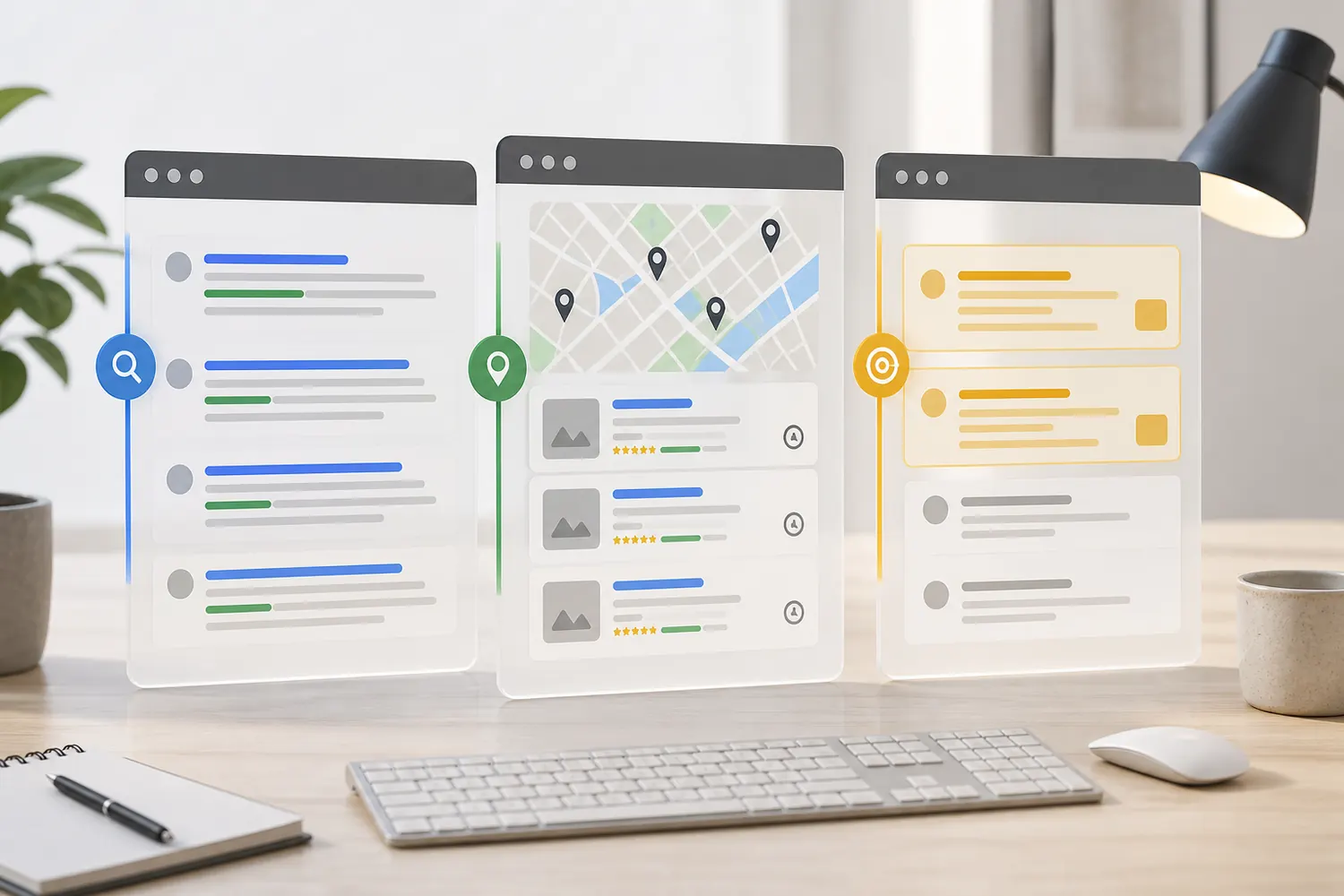
Organic results, the map pack and ads serve different jobs
A search results page can show several types of visibility. Knowing which one fits the query stops you from measuring the wrong thing.
| Search placement | How it appears | Best fit | Main inputs |
|---|---|---|---|
| Organic result | Standard webpage listing | Services, products and research queries | Relevance, content, technical health, links and trust |
| Local map pack | Map with nearby businesses | Location-based and “near me” searches | Business Profile relevance, distance and prominence |
| Search ad | Sponsored placement above or below results | Immediate demand and tested commercial keywords | Targeting, bid, ad quality and landing-page fit |
Organic SEO builds an asset that can attract visits over time. The map pack helps a local business win calls, directions and website visits. Google Ads management can create visibility while organic pages mature or support campaigns where the business needs faster feedback. This comparison of SEO and Google Ads explains when each channel earns a place in the mix.
The realistic path to get on the first page of Google
The realistic path to page one starts with a narrow set of searches tied to profitable services and a defined market. You then improve or create the best matching pages, make them easy to crawl, establish local and industry trust signals, and measure qualified traffic rather than watching one headline keyword.
- Set a commercial goal. Pick the calls, quote requests, bookings or online sales that search should produce.
- Benchmark the starting point. Record indexed pages, current queries, conversions, Business Profile activity and technical problems.
- Group keywords by intent. Separate research searches from service, product and location searches. One page should serve one coherent topic.
- Fix the pages closest to winning. A relevant page sitting in positions 8 to 20 often deserves attention before a brand-new article.
- Build supporting coverage. Publish useful answers that link naturally to core service pages and demonstrate real experience.
- Review performance monthly. Track impressions, clicks, qualified leads, conversion rate and movement across a group of valuable queries.
A documented 90-day marketing strategy helps an owner decide which work comes first and which metrics will decide whether it worked.

On-page and local work that improves Google ranking in Australia
On-page SEO tells Google and customers exactly what a page covers. Local SEO confirms where the business operates and whether people in that market recognise it. Australian SMBs usually need both.
Get the page basics right
- Write a unique page title and H1 around the search intent.
- Answer the main question early, then add proof, examples and useful detail.
- Use descriptive URLs, headings, image alt text and internal link anchors.
- Add service areas only where you can support them with genuine local detail.
- Make phone numbers, forms and calls to action easy to use on mobile.
- Check indexing, canonical tags, redirects, broken links and Core Web Vitals.
Thin suburb pages rarely earn trust when the only change is a place name. A useful local page explains what the business does in that area, includes relevant examples, answers local questions and connects the reader to the right service. The same principle applies to blog content: useful specificity beats repeated keyword variations.
Strengthen the local signals
Google says local results mainly depend on relevance, distance and prominence. Complete your Google Business Profile, use the correct category, keep hours and contact details accurate, add current photos, and respond to genuine reviews. You cannot change the searcher’s distance, but you can make the other signals clearer.
The full process is covered in our article on how to rank higher on Google Maps in Australia. Service businesses can also use this local SEO plan for nearby customers to connect website pages with Business Profile activity.

Why some keywords remain out of reach
A new or lightly established website may struggle to beat national brands for a broad term such as “insurance”, “lawyer” or “accountant”. Those results often reward sites with years of relevant coverage, strong brand demand, authoritative links and pages built for several search intents.
That does not make SEO pointless. It changes the target. A suburban accounting firm has a stronger case for “small business tax accountant Parramatta” than “accountant Australia”. A supplier may gain more qualified enquiries from a specific product-and-industry query than from a high-volume category word.
Pick targets with business value and a credible route to page one
Assess each keyword against four questions:
- Does the search match a service or product you want to grow?
- Can you create a page that fits the intent better than the current results?
- Does your location, experience or specialisation give you a defensible angle?
- Will a ranking bring likely buyers, or only casual traffic?
Longer searches often carry clearer intent. Our analysis of long-tail SEO trends in Australia shows how these terms can support a broader topic without forcing every page to chase the largest search volume.
How long does it take to reach the top of Google search?
Some technical and local changes can affect visibility within weeks, while competitive organic growth often takes several months. The starting condition of the site, competition, crawl frequency, content quality and authority all change the timeline. A fixed promise of position one by a set date ignores those variables.
| Period | Typical work | Useful signs of progress |
|---|---|---|
| First month | Audit, tracking, technical repairs, keyword mapping and Business Profile cleanup | Indexing fixes, cleaner data and early impression changes |
| Months 2–3 | Priority page updates, new content, internal links and local signal work | More ranking queries, stronger positions and better landing-page engagement |
| Months 4–6 | Content expansion, digital PR, link earning and conversion improvements | Page-one gains across selected terms and more qualified organic enquiries |
| Beyond 6 months | Repeat what works, defend gains and expand into harder topics | Broader visibility and steadier search-led revenue |
This is a working range, not a guarantee. A technically sound site in a small regional market can move faster. A new website in finance, legal services or a national ecommerce category will usually need more evidence and sustained effort. Our Australian SEO timeline covers the variables in more detail.

Get a ranking plan built around your business
A useful ranking plan names the pages to fix, the searches to target, the evidence each page needs and the order of work. It also connects rankings to calls, leads or sales. Otherwise, a business can spend months celebrating traffic that never reaches the sales pipeline.
Circular Marketing starts with the current site, competitors, search demand and conversion data. If you want a practical route to get on the first page of Google, request a search visibility review. You’ll get a prioritised plan based on the opportunities your business can credibly win.
Key takeaways
- Define whether you want organic, map pack or paid visibility for each search.
- Target specific, commercially useful queries before chasing broad national terms.
- Build pages around intent, local proof and first-hand expertise.
- Fix technical access and mobile usability so good content can perform.
- Judge progress across qualified traffic, leads and a group of target queries.
Final thoughts
Businesses reach the top of Google by earning relevance and trust query by query. Start with the opportunities closest to revenue, do the basics well, and keep improving the pages that show real demand.